Sunday, January 27, 2013

Phase 5 - be brave, every decision involves loss, conclusion

Now
In October 2012

Since phase 5 deals with loss, I've been thinking about the definition of "loss." In particular, wondering about the difference between loss and compromise? To me, compromise is a loss that one accepts in exchanged for a perceived gain. If it's a "perceived gain," then the difference between a compromise and a loss is metaphysical (it relies upon perception). Does the "perceived" aspect of the definition open up a space to turn loss into compromise, not by avoiding loss, but by identifying a perceived gain?

Haha - so I've been giving this a lot of thought because I got rejected last week for a big grant. I think of applying for grants/residencies/funding as part of my job as an artist and getting rejected as something that (sadly) goes along with that; so, rejection is not an unusual occurrence for me, but this one was especially disappointing. Applications are only accepted every 2 years, and this was my third time applying - I had the re-application date on my calendar for 2 years - plenty of time to think it through and give it my all. In terms of trying to see it as a compromise rather than a loss, maybe it's an opportunity to reassess?

I've been listening to "The Power of Habit" by Charles Duhigg and thinking about ways I might try to compartmentalize blocks of time and develop routines so that I can devote more physical and mental energy to art-making (like confining house projects to weekends or doing cookie baking for the week on Sundays). I've been waking up early to work in the studio (I am not a morning person - but a little bit of self-bribery in the form of making a cup of my favorite fancy coffee goes a long way ;)). I think it's been working well, but I'm still implementing the corresponding part of the plan to try to get to sleep earlier. In terms of space, I'm going to narrow my geographic focus to apply for only shows/residencies/fellowships within 120 mile/2 hour radius (unless there's a compelling reason to do otherwise.)

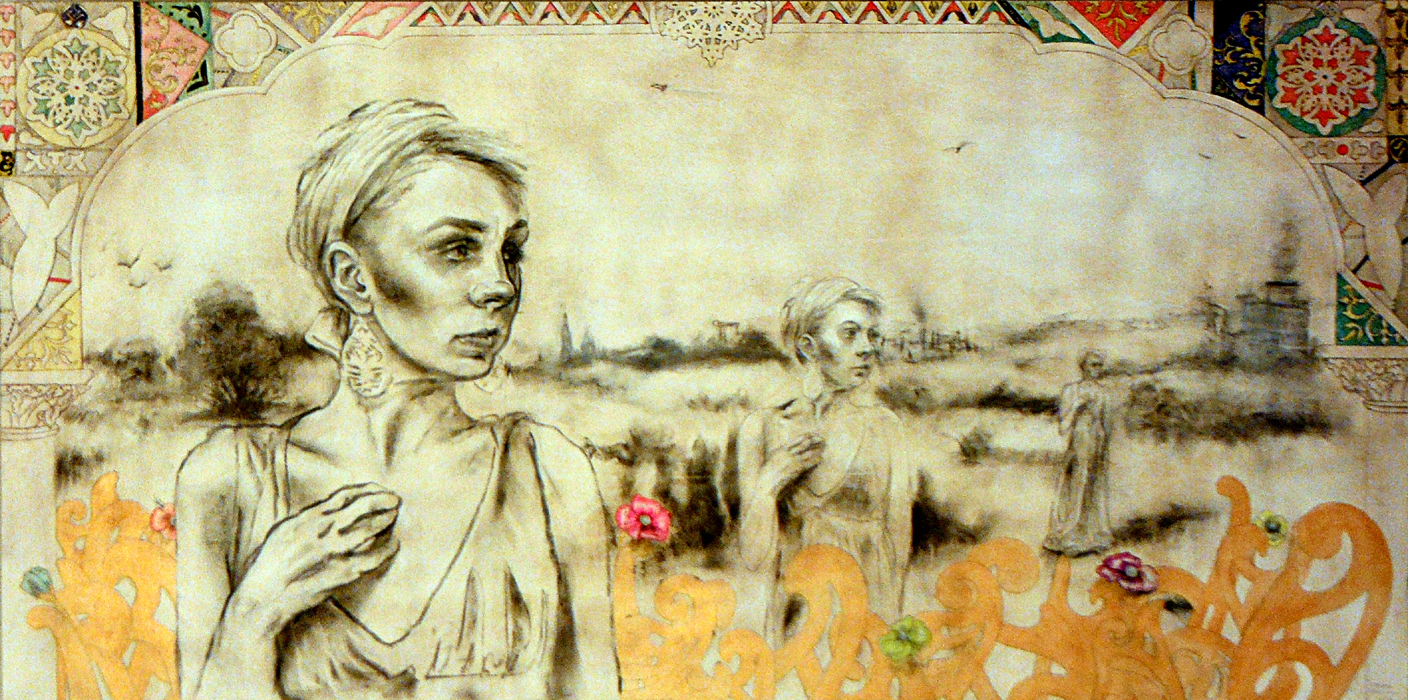
Now on to the (hopefully!) more entertaining part. In the studio, though I said I wasn't going to work on the tracery piece anymore, I lied. Not only did I work on it - I did something a little scary.  I covered the whole thing with a thin layer of black (I included a photo from October for comparison). I think it actually is close to finished now...really.

I'm still slowly working on the 9 repeating parrots (7 swans a swimming, 6 geese a laying...), and I haven't forgotten the dolls. I needed to step back from those and did some research on historic masks/faces at the American Museum of Natural History and went back to look at the decors at MoMA - I think the problem I'm having moving forward with them isn't about the dolls themselves, but that maybe each one needs a home/environment too. Hmmmmmm.


I also started something new :). It may not look like it, but there's about 5 layers of sanded (clear) gesso on that panel. 

And because I can't help myself - a cute kitty picture. It was very cold this week, but my clever feline assistant figured out the warmest (safe) spot in the house was on the fireplace, (and I spent a good amount of time with a book  nearby too.)

Monday, January 21, 2013

Phase 5 - be brave, every decision involves loss, update


This past week I was invited to submit a piece to the show “Fluxus, now then and whenever” curated by the fabulous Gregory Steel at Indiana University Kokomo. Instead of using one of the (literally!) 50 minis I have all over the house, I decided that I’d really like to try to make something new based on the idea of containers/containment that’s been on my mind lately. (And now we come to the point in this story where I ask myself “am I crazy?,” and answer comes back “O yes, for quite some time now I should think.”) Over the weekend, I made 6 new minis, painted/adapted their frames, and modified a lunch box to house them (re-purposing some of the cleaner newspapers from 1946 that I pulled up from under the carpet.)
   
I'm especially proud of this mini Dutch-inspired still life, and recognize the pose of the parrot and the cityscape from last week?

I also kept working on the tracery piece.(There are lots and lots of layers on the still life, so I went back and forth while they dried.) Naturally, I worked on the flowers (and tiny ants.) I think it’s funny that the cathedral from the tiny print in the fluxus piece reappeared in the background of tracery piece, just to the right of the face. It may be time to set this one aside for a while, and start something new.


In terms of this week's theme, I’ve been thinking about a radio interview I heard on the BBC with a politician. He was speaking about the sculpture, “Angel of the North,” by Antony Gormley (I haven't seen it, but this piece by the same artist in the British Museum would be on my list of personal favorites (though any list of "art I like" would be a very long list :)). To paraphrase, he said - it’s lovely and all, but if it didn’t exist, 99% of people wouldn’t care. I find this comment devastating (and memorable) because, on the surface, it seems so reasonable.  If I had done something else with my time this weekend, no one would have felt any loss over these minis in a box except me (and I would have felt only a virtual loss – a reduction of possibilities). Until an artwork exists it's nothing (in the sense of no-thing, not-a-thing), so it can't hold a place in the loss column (except to the artist, who might mark it as a "0"). But "0" is very different than nothing mathematically because it does hold a place. (I'd be excited to win $1, but I'd be more excited to win $10, and even more for $100...and so on to the jackpot). That's straightforward because it changes the amount, but even when it doesn't: .10 is different from .1. The extra zero indicates the possibility of measuring further and so it suggests the existence of alternatives (.11 or .12) that .1 without the zero doesn't for me. I'm not quite sure where I'm going with this, (blame it on mini-induced exhaustion ;)), but I think I'll keep working on Phase 5 a little longer.


Wednesday, January 16, 2013

Phase 5 - be brave, every decision involves loss, update

Good News! Mini #39 will be on exhibition at the 
National Association of Women Artists' Gallery
in New York City from February 6 - 28th!
See the Press Release below:


Exhibit: Open Small Works Exhibition
Location: The N.A.W.A. Gallery, 80 Fifth Ave. Suite 1405, New York, NY 10011
Dates of Exhibit: February 6 -February 28 2013
Reception: February 13, 2013 5-7 PM

212-675-1616 *** office@thenawa.org *** www.thenawa.org 


 The National Association of Women Artists, Inc. (N.A.W.A.) presents this year's Open Small Works Exhibition at the N.A.W.A. Gallery, in February. This group show is highly anticipated because it is opened to both N.A.W.A. members and non-members. Each year we get many entries from all over the U.S. The first prize for this exhibit is a solo or two person exhibition at the N.A.W.A. Gallery. The second prize is a free half year N.A.W.A. Membership. The featured original works selected by the jurors are in various disciplines, and created in 15 x 15" (or smaller) format. We know that this will be an exciting, vibrant exhibition, as always!
  
The first established women's fine art organization in the U.S., N.A.W.A. is documented and archived in numerous Art Institutions, museums and libraries throughout the country. Its mission has always been to promote and support the artistic talents of women.


National Association of Women Artists, Inc.
80 Fifth Avenue, Suite 1405
New York, NY 10011
212.675.1616
"LIKE" us on Facebook! www.facebook.com/theNAWA 

using this view for a painting - somehow

Home again from New York!  I saw so much art, I actually can't describe it all, but favorites included: The Picasso Black & White show at the Guggenheim, Munch drawings at Moma, return to the Quay Brother's one last time, a small exhibition at the Met on the influence of African art in mid-century New York, and the contemporary show PAINT at Betty Cunningham Gallery. It sort of feel like an art version of post-Thanksgiving stupor, where I've ingested so much art that I'm sleepy.   

minis in a box
I enjoyed being in New York, but I'm also happy to be reunited with my feline assistant and back in the studio. Cliche though it is, when I'm not making art, I'm thinking about making art, and one thing I thought about in New York was compartmentalizing. In some ways, it seems like maybe the minis were an attempt to compartmentalize in space, while Tempus Fugit is an attempt to compartmentalize time. 

In terms of facing loss that comes with a decision, I was realizing that with the tiny prints, I took a process that could have been economically viable and gradually turned it into something that's totally inefficient. While I enjoy making them and plan to continue, I also need to find a more viable model. So, I started wondering if there's a way I can compartmentalize inefficiency? Are there processes that use efficiently? I remembered that I was extremely efficient when editioning the etching below because I had very limited press time.

Raven etching from summer 2011
I started making these wooden tiles, drawing the same image over and over in ballpoint pen, then spray gessoing over them.  I'm thinking that by the time I get to the end, I'll be able to draw the image on a metal plate to etch very quickly (after practice, practice, practice). While this piece is incredibly inefficient, from it, I can create a metal plate to edition. I like this idea (though I still need to find etching materials and a press with etching baths, but those are concrete issues.)

I also had some time to think about this one. I decided the green was the right color, but in the wrong place. If it looks "mistier," it's because I sprayed white over the whole thing (twice). EEk! I definitely had to pause for a few moments of "this is either a very good, or very very bad idea," but in keeping with phase 5, I decided that if I ruined it beyond fixing, well, it wouldn't be the first time (or second, or third, or.... ;) )

Wednesday, January 9, 2013

phase 5 - be brave, every decision involves loss, update


I did it! I put a color in the background of the tracery piece.  I kind of like that it's the color (and consistency at one point) of slime - the tracery is separated from the slime by a thin gold line, but the figures are not quite so lucky ;).  With the color, it looses some of the visual connection to medieval manuscript painting, but hopefully it gains a stronger connection to contemporary painting. I'm still thinking through the color choice though (I feel like the volume needs to go either up or down on it, but it's a step.)

I also "finished" the piece with black scrollwork.

 I went back to see the Quay Brother's exhibition again, but this time I focused on the diorama-like rooms they build for the puppets, and while I was there, I got some ideas from Munch's block printing process (he cut his block like a puzzle, inked it, put it back together, then printed all the colors at once - genius!)

I also saw the "Picasso: Black and White" show yesterday at the Guggenheim -hmmmm, still thinking about that one, but I thought it was timely for me.  I refined these a little this past week (the minis were #43 )


 The internal framing and predella gave me an idea - I'm wondering if there's a way to compartmentalize the inefficient part of the drawing/painting process instead of trying to eliminate it? Hmmmmmmm.

Thursday, January 3, 2013

Phase 5 - be brave, all decisions involve loss


Just a quick update - still working up to the tracery piece, but in the meantime, I started this on Sunday with the new grisaille pastels, gold ink, and black paint on fabric - I think it's really coming along (can procrastination ever be productive?)

  I also worked on the floors - can you tell which half has received TLC (*trick question - answer: both) This is after removing carpet, newspaper, and linoleum and scrubbing both sides repeatedly, but the left half also got a new layer of stain and buffing with wood polishing oil (lots and lots :))

Sunday, December 30, 2012

Phase 4 - acknowledge limits, conclusion


The week between Christmas and New Year’s is always a kind of sad week for me as I sort and organize as a way of letting go of one year and preparing for the year ahead. One of my missions this week was coming up with and implementing a system for Tempus Fugit photos (I ended up creating a project folder with folders for each phase with all the photos placed in subfolders by date posted. In a separate folder within the project folder is a place for the artwork only, divided into subfolders by month.) I think the system will help keep the photos organized moving forward (and during Phase 2 (be prepared for good things) I invested in a back up system – thinking it’s hard to be prepared for grant applications, etc. without documentation, right?) So the photos are now all safe and organized, and I updated the artist site with a new section for Tempus Fugit. Going through every photo for the project starting in July 2012 helped me acknowledge limits in a few ways.

One thing that stood out about the work is that, though I work quickly, my process is consistently inefficient. To illustrate - I carried out the idea of a gift edition of tiny prints (pictured last week). The prints are each hand printed because with the cuts in the surface re-fuse under pressure. Each block only yields a small edition (the latest was 25). Then, they’re collaged (adding an “unnecessary” element), and because they’re circles, each one gets cut out by hand (no paper cutter.) Then I like to use a dark border in the image, but I don’t like the white on the edge of the paper to show, (so I tone the edge with color pencil.) Then I mounted these to a 4 x 6 inch paper so they could be framed, (adding an additional layer of paper rather than printing them directly onto a 4 x 6 page.) Since I arrived at this process after months of refinement, the inefficiency isn't accidental. I think it relates to the premise of Tempus Fugit – that the dedication of time/space is a ways of showing devotion. That by making the process time consuming, I increase the time I spend with each work as a way of investing it with my devotion (which can’t be directly measured).

I’ve been continuing to work on the larger work with the tracery and repeating figures, and while it looks different than the tiny prints, I think the idea is similar in that I’m covering the areas of tracery with color in a very time consuming way – with tiny parallel lines in ink instead of paint. Not only is this a way of investing myself in the work, but it creates a contrast with the figurative part of the image in terms of touch vs. something that can't really be touched directly (or all those little lines smear). Each is a way of investing the self, one through direct contact and the other through investment of time. The iconography of the tracery is Gothic, and the idea of investment of time as a form of devotions is also, I feel, Gothic, because in Gothic art, the devotion of the maker seems more important than whether or not there are “mistakes” (for example, the famous “crazy vault” of Lincoln Cathedral, where the ribs on the ceiling are askew). The imperfection could be read as a sign of­­­­­­ the humanity of the maker. 
But even if that’s true – reading Lyotard’s Inhuman and having seen the show Wade Guyton OS at the Whitney a few weeks ago (a very interesting show – recommend, wrote about it for work here, and it’s still on view for about 2 more weeks), I guess makes me question whether that element of humanity is of value in an image, and does it matter that it’s produced by a human in this way instead of some other way? hmmmmmm.

Organizing the photos was a great way to see the artwork on its own without house projects, baking creations, or even cute kitty photos, but it reminded me that this project really wouldn’t be very interesting if it were all talk and no doing/making things. In terms of a practical application - I’ve been considering a big change to the tracery piece and it’s taking me a while to work up to it even though, once started, it will have to be done quickly. Thinking about it for days isn’t a way of deciding, I think it’s more of a process of letting go of one phase and accepting that once changed, the current state will be lost forever.  So, on that note, I think that’s a perfect place to stop for 2012 and start 2013 with Phase 5 – be brave, every decision involves loss.
Going through the photos, I also realized that, with the 
exception of matching colors already there, I've only
been painting the house with shades of white and grey,
so I decided to get myself a little present.
 (those are tiny prints in process in the background)


Happy New Year and Best wishes for an art&happiness-ful 2013!

Thursday, December 20, 2012

Phase 4 - acknowledge limits, update 4


This past week has been overflowing with art/music/animals and baking activity.

I went to the American Museum of Natural History to see butterflies. I’ve written about butterflies a couple of times before on the blog, and they show up in work. A few weeks ago, I heard a lecture by academy award nominated director Courtney Hunt (and wrote an article for work about it). One of the things she said that struck me was in response to a question about how she got her ideas for films. She talked about how she has lots and lots of ideas - most of which never develop into films - but when an idea comes back over and over, she know that that’s an idea to purse. I like butterflies because they have a symbolic connection to the soul (the word for butterfly, “psyche” in ancient Greek, is the same as the word for soul) and beyond that, they are so impossibly fragile yet full of movement and life - they're like color incarnate. I’m not quite sure what I want to do with this idea yet, but I took lots of photos.

I continued holiday cheery-ing by making mini-cards.
and gifts. I liked the idea from phase 2d of making an edition of a tiny print to give. I’m learning too in terms of accepting limitations and asking for/taking expert advice. I tell friends and family when I give them artwork (and new cookie recipes too) that they're helping me by sampling/testing, and it’s true. One friend's response to a tiny print was that she loves the print, but finding a frame has been difficult. I don’t want to change the size of the patterned paper or prints, and I can’t offer them framed right now, but I decided to attach the latest edition to a backing that fits in a standard sized 6 x 4 inch photo frame (the change has received thumbs up).


I thought I’d reached the end of my holiday baking, but it turns out, it was really more of a pause. I used doing more baking as a little bit of self-bribery – that if I dealt with some difficult things, only then would there be more baking. It turns out, baking is an excellent motivator.


So because I’ve been working on my kitchen and doing a lot of baking lately, the time/space organization of my kitchen has been on my radar more than usual. This is a bit of a tangent, but it does relate to the time/space management aspect of tempus fugit.

I eat oatmeal almost every morning with different fruit and spices in it and have repeatedly put chili powder instead of cloves in my breakfast by accident. This bothers me because I hate wasting any food, and it’s especially frustrating to make the same mistake over and over. So in terms of phase 4 – acknowledging limitations, I tried to step back and consider if there are limitations that I can work with to come up with a new solution. I concluded that I mix up cloves and chili powder even after I tried storing them in different locations because the jars look the same (same brand, same color spice). They’re labeled, but I must not really read the label, or if I do, it’s not enough to override the visual identification I’ve already made. While I may be able to train myself to read the labels every time, that’s really more time than I want to devote to this. So I thought I'd try a more visually-oriented organization based on color. I found the jars and rack at a dollar store (cost – one cup of fancy coffee – score!) I picked out the 6 spices I use almost every day. Breakfast spices are warm color jars, lunch/dinner are cool color jars. The color lid is associated with the contents (pumpkin pie spice mixture is orange, cinnamon is red), and I mixed some cumin in with the chili powder, since I always use them together, so that it looks different than the cloves (and it's in the green jar as far from the warm toned breakfast spices as possible.) I decided to forgo labels, since (apparently) I don’t read them, in favor of a better view into the jar to keep track of refilling. I haven’t mixed up anything so far using these. On the one hand, I know it is foolish to be thinking about butterflies, spice jars, and art when there are far, far more pressing issues nationally and globally; but on the other hand, this was the problem I could solve this week and coming up with a solution made me feel better prepared to tackle bigger issues.
reworking started in the upper right corner and will move toward the lower left.
I got some thoughtful and helpful responses to my question last week about photographing work better and tried to make improvements within the existing framework of time and space. I thought about the source of the issue and concluded that maybe my challenges photographing the whole piece derive more from limitations in seeing rather than photographing. I don’t think I actually see the whole piece at one time. I see it more as fragments of detail to be mentally reassembled, and that may be why I like the detail shots so much.  Presenting it as a conglomeration of areas is closer to how I actually see the work. However, because it’s important to be able to present the piece as a whole, I changed the bulbs in my studio, doubling the brightness with much more energy efficient, wide spectrum, compact bulbs that give off light which is closer to daylight. I went back to working on a piece from the summer that I don't feel is working yet, but after the carnival piece, I feel better about trying again on a bigger scale.

visual record of the overlap of this week’s museum visit, cookies, and art: